So let’s talk about gearing for a bit. I got back into cycling this year after a long absence, and really wanted to try camping and longer tours. I researched touring/adventure bikes and settled on the Kona Sutra. This bike shipped with a Shimano GRX-shifted 2×10 (2 gears in the front and 10 in the back) that was advertised as a “go-anywhere” setup. The problem is, it became apparent pretty quickly to me that the gearing was designed for a much stronger rider than me, or really than most average people. TLDR; change your cranks and chainrings. It’s worth it!
At first – like a lot of folks – I imagine, I thought I just wasn’t in shape enough, and that “anyone” would be able to push these gears. And they are not unreasonably high. The stock setup has 46/30 chainrings and a rear cassette with 11-36 sprockets. It was lower than a lot of classic road bikes, after all.
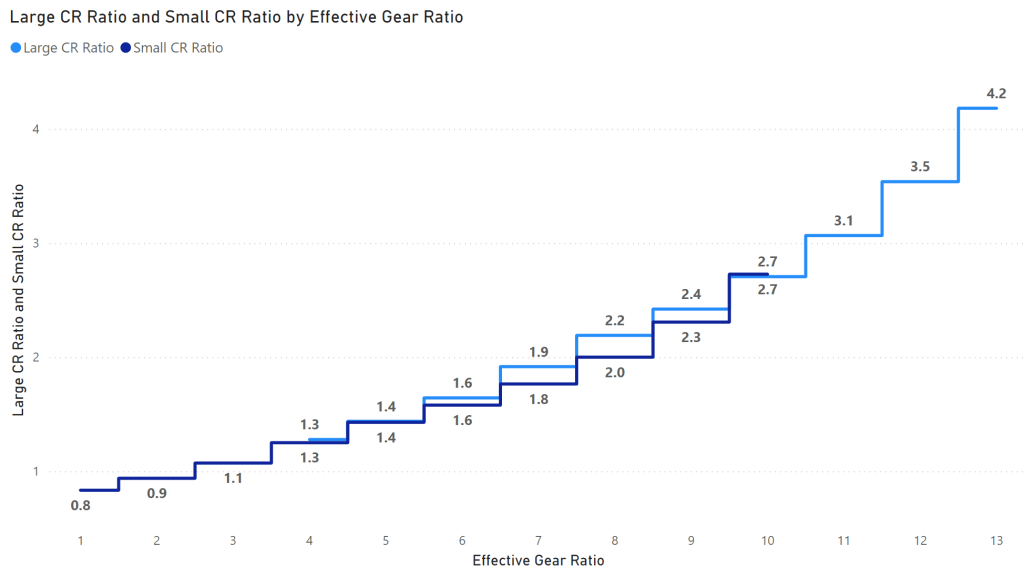
But my experience riding the bike in the real world was that in fact I could not climb a steep incline, especially with a load on the bike, and further that I never used the upper gears at all. This chart shows the lowest and highest gear ratios on the bike. My issue was that the lows were not low enough to climb steeper hills, and the highs were so high I had no use for them.
I started to do a little research, and found I was not alone, and that a lot of folks had to “fix” the gearing on this, and really almost all, current bikes. First I found Mat Ryder discovering he needed a larger cassette to contemplate his TransAm ride this year. Then I found Russ at the YouTube channel Path Less Pedaled, who has been observing this problem for years. Bike companies focus so much on racing or competitive cycling that they have drifted out of step with a lot of ordinary folks like me who would like to tour and not push a huge gear.
Being conservative, I rode the whole season on the stock gears just in case I would eventually become strong enough. But after a 5 day camping trip and months of riding, I gave in to the fact the stock gears just were wrong for me.
There are basically two ways to fix this issue: replace the cassette in the back with one that has a wider range, like 11 to 42 teeth instead of the stock 11 to 36. This can get you a suitable climbing gear for steeper hills.
Alternatively, you can attempt to replace the chainrings in the front. The challenge there is that many manufacturers have settled on crank sets (the bits that connect your pedals to the bike at the bottom bracket and hold the chain at the front end) so that you can’t just replace the rings with any smaller sizes. They are either fixed in place or the size of the mounting bits is too large in diameter to fit a small enough gear.
Fix the Crankset
All due respect to those who fix this with the cassette out back, I opted for replacing the cranks and bottom bracket so I could get chainring sizes that lower all the gear ratios across the board. Why?
- It does fix the low/climbing gear problem
- I never used the highest gears, and replacing the chainrings makes those accessible, so I have an actual 2×10 instead of a hypothetical one.
- It keeps the spacing between the gears closer together in terms of ratios – which means I can keep my cadence, the speed I am pedaling, to the rate where I am comfortable at different speeds. I don’t have to create a bigger gap from one gear to the next. That gapping doesn’t bother some people, but I would rather not have it.
Russ, it turns out, had nailed my issue exactly. He has a whole series on fitting better chainrings, and therefore the required cranksets. I started with this one These Cranks Are BETTER Than Shimano and SRAM – YouTube and then watched them all.
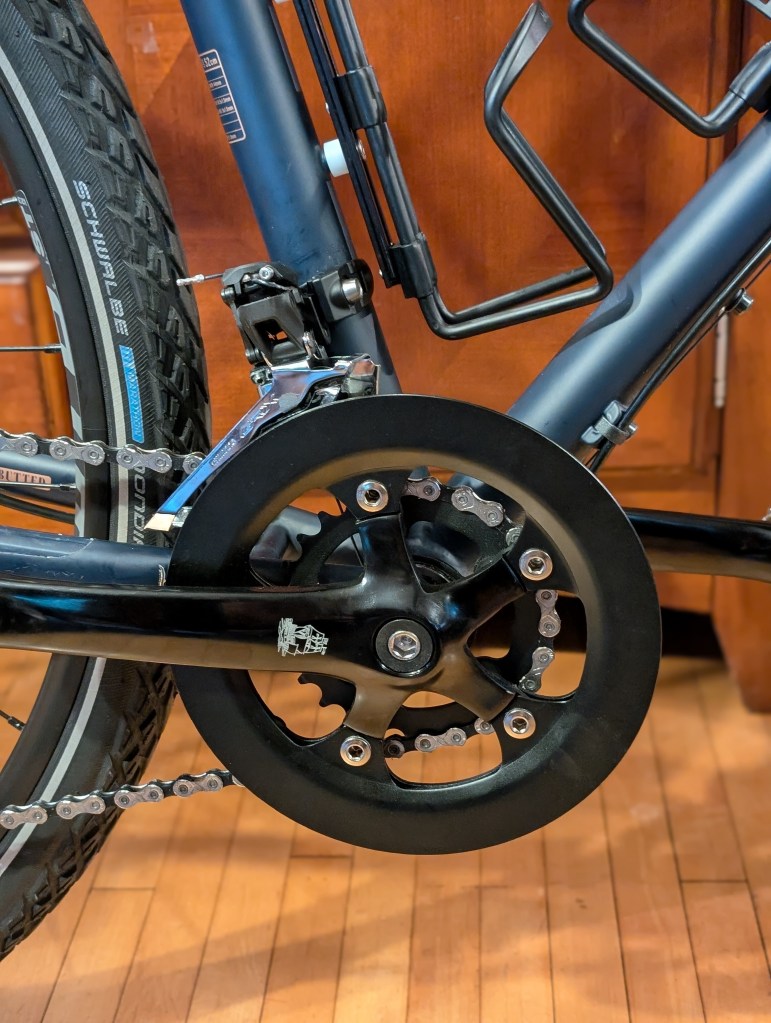
I settled on a set from Rivendell called the Clipper, mostly based on cost. This crank, as I understand it, is a reproduction of an old one that was designed back when gearing for touring bikes had more range. I believe it was a triple design originally, but in addition to the triple now can be purchased with just with two chain rings and a guard, which is what I opted for. Russ calls this a “Wide Low” setup – low because you have those climbing gears, and wide because there’s a decent difference between the two rings, giving a wide range.
The new chainrings took me from the stock 46/30 to a 42/26.
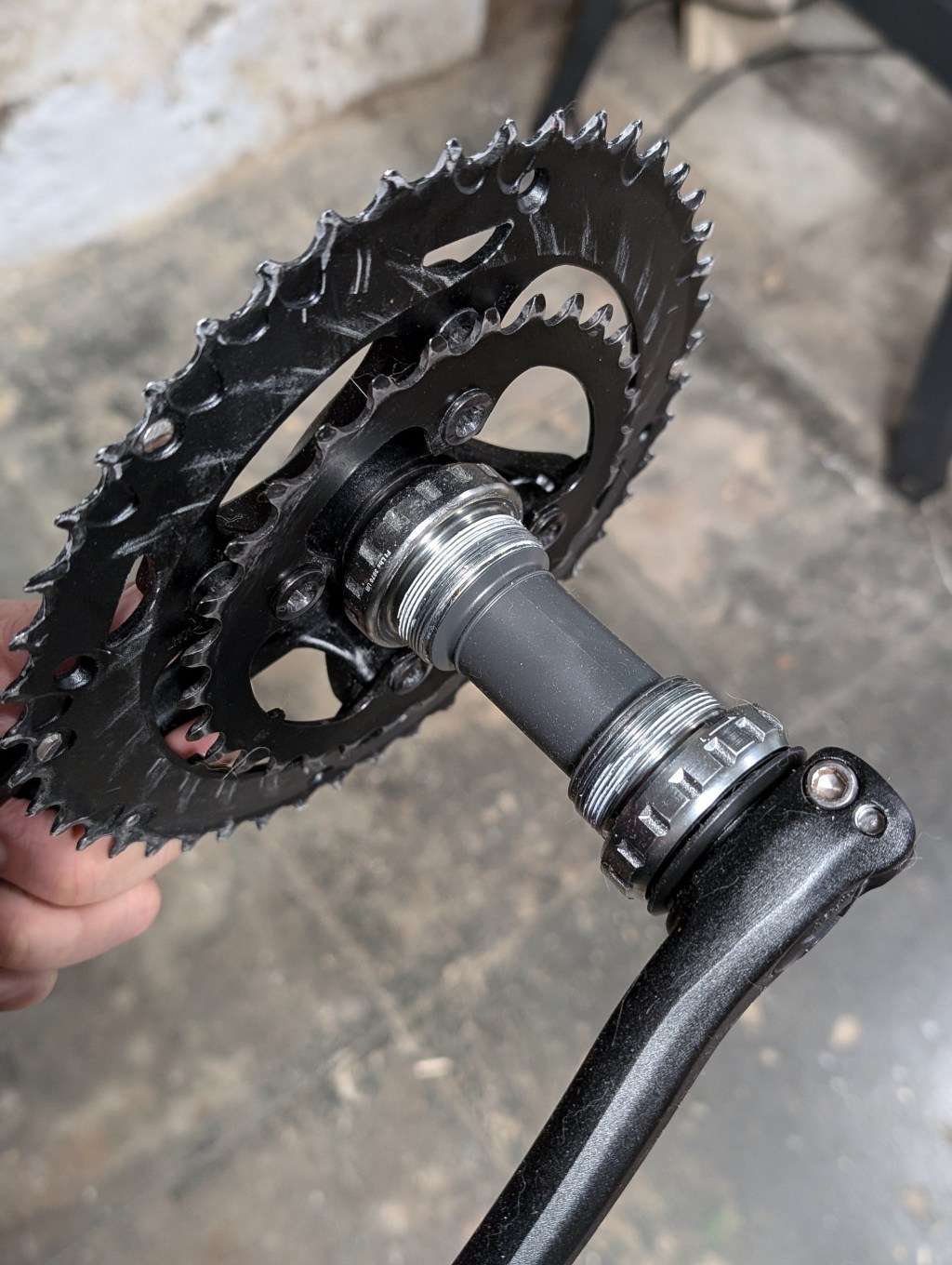
In order to make this change I also had to change the bottom bracket itself, from a modern design that has the “axle” shown at the top of this post, to an older design called “square taper” where the crank arms are bolted onto square ends on the axle instead. Don’t be scared off by the “older” design – it’s perfectly suitable and works great. I rode thousands of miles on a square taper setup back in the ’80s and ’90s. On this bike there is no problem swapping them out. It’s slightly more expensive to have to replace that part, but totally worth it in the long run.
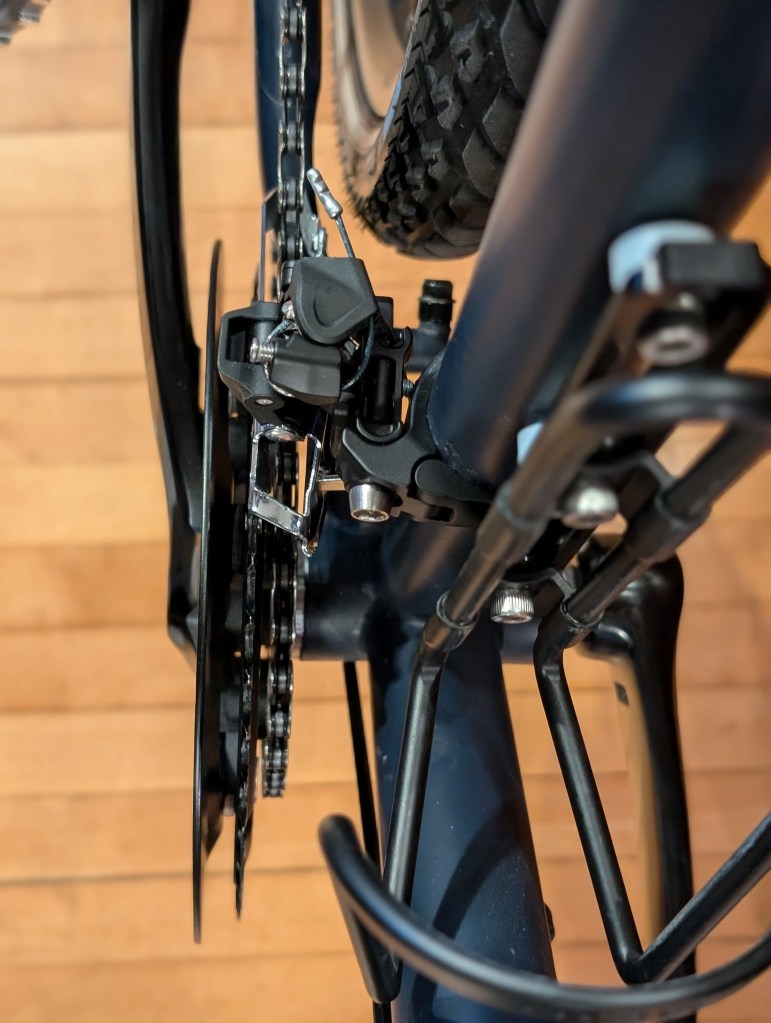
The shop that installed this for me was great. I was able to reuse the existing GRX front derailleur. The chain needed to be shorter by a few links, and since my old chain was about 75% used up, they put a new one on.
The only challenge was the spacing between the two rings left to right. To make it shift smoothly I believe they put some small spacers in that move the larger ring closer to the small one by about 1mm.
Here’s the before (gray, stock) and after gear ratios so you can see the difference:
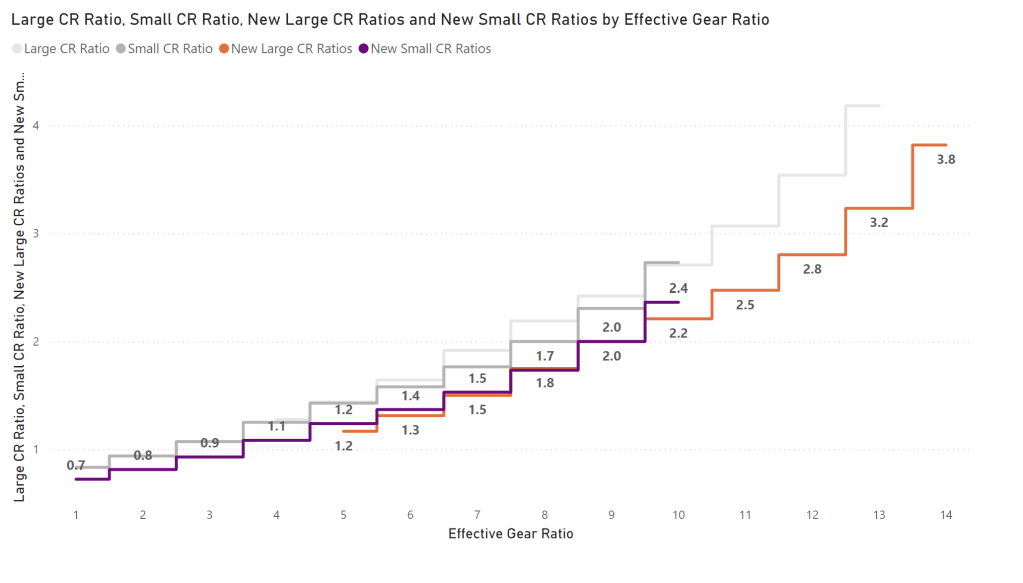
Here you can see the whole gearing range is shifted lower. Interestingly, I make these charts as the distinct different gear ratios, which is sort of like every actually different gear accounting for the overlap between large and small chainrings. This setup gives me one more real gear, for a total of 14 instead of 13. Best part is, as Russ preaches, I can spend 90% of my time in the big ring now, and only downshift the front when I need to climb. Then when I need to I can reach down lower at the bottom end.
I did an overnight with all my gear and this new setup, and it’s fantastic. Everything else on the bike is stock but this was a game-changing mod. Highly recommended.
 The Pragmatic Cyclist
Leave a comment